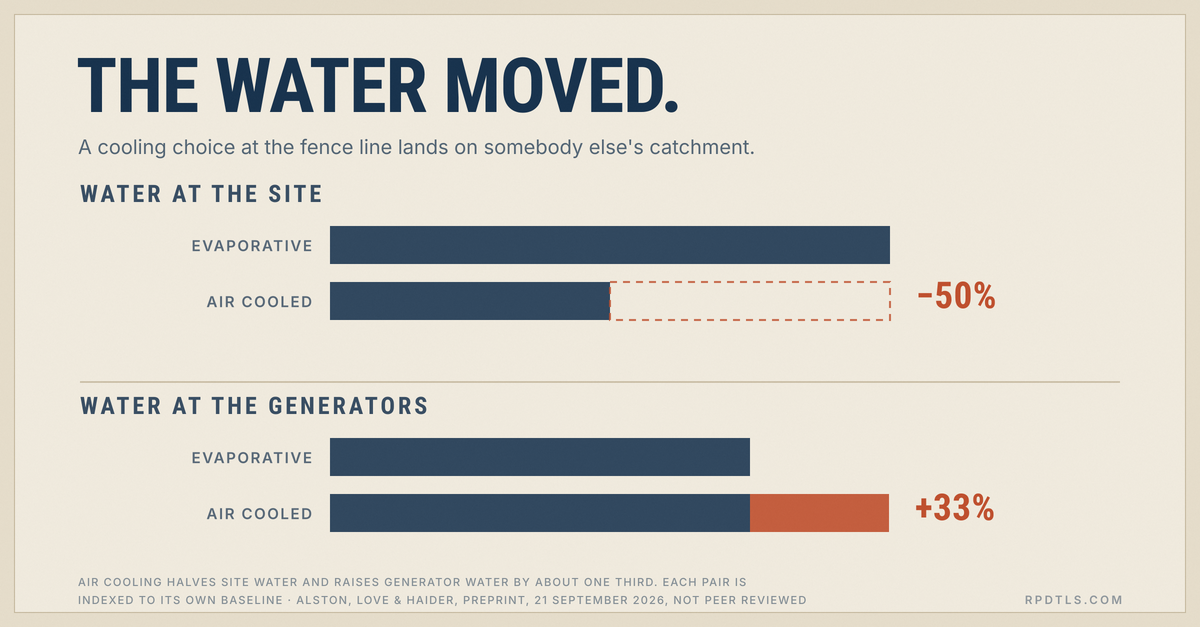
Switch a data center from evaporative to air cooling and its water use roughly halves.
The power system then picks up about a third more, in someone else's catchment.
That is the result of a University of Michigan model published on 21 September. The paper is a preprint and has not completed peer review, so its exact numbers need that qualification. The mechanism is the important part: a decision at the facility reduced on-site water, increased electricity demand and moved part of the water footprint to generators in other sub-basins.
The water did not disappear. It changed address.
The data center saved water. The power plant would like a word.
A very wet three weeks
The last three weeks have produced an unusual cluster of AI-and-water developments.
On 8 September, Rystad Energy estimated that direct water used for data-center cooling could rise from 222 billion liters in 2025 to 644 billion liters a year by 2030 in its central scenario. Its aggressive water-efficiency case still reaches 388 billion liters.
Rystad also quantified the compromise hidden inside the word “dry.” Dry cooling can save roughly 2.15 liters of water per kWh of IT load, but it may require an additional 0.30 to 0.74 kWh of electricity. In the United States, indirect water linked to electricity can exceed direct cooling water by more than two times.
On 9 September, QTS announced a $1 billion water-stewardship pledge, including facility design, infrastructure funding and watershed projects. It is a material company commitment and a future claim, so its measurement boundary and verification method will matter.
On 17 September, Australia published a consultation paper on AI infrastructure. It proposes nationally consistent mandatory rules for large data centers: minimize water, prioritize recycled or non-potable sources, plan for drought, report transparently and pay a fair share of the water infrastructure they require. It estimates that Australian data centers consumed about 5.5 gigaliters for cooling in 2025, equal to 0.04% of national industrial water use. That percentage is reassuring in the way an average annual temperature is reassuring during a bushfire. Water constraints happen in a place, at a time, under a permit, with other users already attached to the same system.
The consultation closes on 9 October. It is the only development in this article that a reader can directly influence this week.
On 21 and 22 September, the European Commission proposed a common rating scheme for data centers above 500 kW and opened consultation on minimum performance standards. The rating covers measured energy and water use, waste-heat reuse, clean energy and grid flexibility. The first labels are expected in 2027. The announced rating is an information instrument; the separate minimum-standards proposal is still under consultation.
Together, these developments mark a change. AI water is moving from a dramatic number in a headline to a problem of definitions, locations, trade-offs, infrastructure and money.
The argument already has consequences. Earlier this year, California's Imperial Irrigation District denied a data-center developer's request for roughly 260 million gallons of Colorado River water a year, and the developer sued. On 17 September, the New Mexico Supreme Court went the other way procedurally: it denied petitions challenging Project Jupiter's air and construction-water approvals and lifted its stays. The court did not rule that the permitting process was lawful; it declined to intervene. Two places, two directions, and a reminder that permission can become scarcer than the equipment.
“Water-free” needs a postal address
Water Usage Effectiveness, or WUE, is useful. It tells an operator how much water a facility uses relative to its IT energy. It can expose waste and support comparison inside a consistent portfolio.
It can also answer the wrong question with impressive precision.
Reported WUE varies enormously with climate, cooling architecture, workload, accounting method and the quality of the water used. Rystad cites AWS regional figures ranging from 0.02 L/kWh in Stockholm to 2.85 L/kWh in Jakarta. That is more than a hundredfold difference inside one company's reporting.
On 21 September, Schneider Electric added another useful site-level comparison. Its modeled optimized liquid-cooling architecture for a 100 MW AI facility cut on-site cooling water by 48% in Dallas and 53% in Paris compared with its modeled air-cooled design. The figures are company-modeled and cover on-site water, which makes them evidence for a design choice and an example of why the boundary still matters.
The point is not that one site is virtuous and the other should sit in the corner. The point is that geography is part of the technology.
A complete water claim needs at least five questions:
- How much water is consumed on site? Withdrawal and consumption are different, and annual totals can hide a summer peak.
- What water is used? Potable water, recycled wastewater and seawater do not carry the same local cost or opportunity.
- What water is consumed to produce the electricity? More electricity can move water demand from the data center to generators.
- Where and when does the impact occur? A liter in a wet catchment in February is not commercially or socially equivalent to a liter in a stressed catchment in August.
- Who pays for capacity and resilience? New pipes, treatment, storage, drought reserves and grid upgrades have owners, even when the sustainability report does not.
These are five checks, not five levels. Different people own the pipes, power, permits and public risk.
“Water-free cooling” may be a sound description of the cooling loop. It is not, by itself, a description of the system. Water has a stubborn habit of respecting physics more than marketing departments.
The bridge to clean-technology commercialization
I have spent three decades working with water technologies. I have seen technically excellent equipment wait because the cost of doing nothing belonged to nobody's budget. I have also seen a modest-looking solution move quickly once a permit, tariff or operating limit gave that cost an owner.
In my forthcoming book, I describe this as buyer-risk asymmetry. Suppliers sell the benefit of acting. Buyers approve purchases when the risk of not acting becomes specific, urgent and theirs.
That is why Australia's proposed fair-share rule matters commercially. A stressed catchment may bear the cost of extra infrastructure and drought resilience, while the data-center operator captures the computing revenue. If the cost remains externalized, the water technology can be socially valuable and commercially homeless. A rule that assigns the infrastructure cost can turn an externality into a budget line.
The EU rating works earlier in the chain. It makes resource use visible and comparable, which may strengthen evidence in procurement. Measurement is still not obligation. A label alone does not create a buyer, but it can make an uncomfortable number harder to misplace.
What should a clean-technology company sell?
The obvious answer is efficient cooling equipment. The commercially stronger answer is a verified operating outcome for a particular location.
That changes market segmentation. “Data centers” is too broad to be a useful customer segment. A better commercial hypothesis might specify:
- AI facilities above a defined power density;
- in water-stressed catchments;
- using a grid with water-intensive generation;
- facing a permit, tariff or infrastructure-capacity constraint;
- where the buyer has an approved budget and a deadline tied to energization.
It changes evidence as well. A credible proposal should show on-site consumption, electricity penalty, water source, seasonal peak, catchment context and avoided infrastructure cost. It should state what is measured, what is modeled and what remains uncertain.
It changes the offer. A supplier might combine cooling hardware, controls, reclaimed-water integration, monitoring, verification and a performance guarantee. The valuable product is not a machine that uses fewer liters in a laboratory. It is a facility that secures capacity, survives a hot and dry week, meets its permit and can defend the result to a utility, a regulator and a skeptical community.
This is also where the AI boom could help the wider clean-technology industry. Data centers are large, visible and time-sensitive buyers. They can pay for better instrumentation, faster learning and new contract structures. Products first proven under AI's demanding loads can later move into industrial cooling, district energy and water reuse.
Or they can produce another generation of excellent pilots that never become repeatable businesses. If the unit economics do not work, adding more GPUs merely makes the problem arrive faster.
How far should the boundary travel?
There is a serious objection to this argument. Follow water through electricity, chip fabrication, construction and steel, and any footprint can grow until it stops helping a decision. Boundaries are not automatically tricks. They make measurement possible. A utility needs the site number because that is what connects to its pipes. A power plant operates under somebody else's permit.
That objection is right about accounting and incomplete about decisions. Nobody needs a data center to report every liter used to make every component. The narrower question is whether a choice made at the site systematically raises water use elsewhere. If a site-only metric rewards the option that increases total consumption, the metric is steering the decision badly. That is a control problem, not an invitation to count the entire industrial economy.
The question behind the metric
The industry does not need a single frightening global water number. It needs claims that survive a change in boundary.
That means reporting the facility and the electricity system, the annual total and the seasonal peak, the water quantity and its quality, the site and the catchment, the technology benefit and the infrastructure bill.
The recent policy proposals and research are early steps. None supplies a universal answer. They do make one thing harder: declaring victory at the fence line.
If an AI facility says its cooling is water-free, the next question should be simple.
Where did the water go?
The University of Michigan result is a preprint and has not completed peer review. Rystad figures are scenarios, QTS figures are company commitments, and Schneider Electric figures are company-modeled. The commercial interpretation and buyer-risk framing are the author's analysis.
Sources and verification note
Sources were checked against the original publisher or issuing institution. Projections, company claims and procedural court decisions are identified as such.
- Australian Government, Department of the Prime Minister and Cabinet, Getting it right: Building AI infrastructure that works for Australia, published 17 September 2026.
- European Commission, Public consultation on minimum performance standards for data centres, published 21 September 2026.
- European Commission, Commission enhances energy efficiency and sustainability of data centres in the EU, published 22 September 2026.
- A. Alston, C. Love and R. Haider, Data center cooling choices shift water impacts across the grid, preprint submitted 21 September 2026.
- Rystad Energy, Data center water consumption could triple by 2030, published 8 September 2026.
- QTS, QTS launches $1 billion global water stewardship pledge, published 9 September 2026. Company announcement.
- Schneider Electric, Schneider Electric advances energy and industrial intelligence for a more resilient future, published 21 September 2026. Company-modeled results.
- New Mexico Supreme Court, Orders in the Project Jupiter air-quality and water cases, issued 17 September 2026.
- KYMA, Data center developer sues IID for refusing water service in Imperial County, published 19 June 2026. Context outside the three-week research window.